Exploring topics in History, Fiction, Mythology, & More
Upcoming Gothic Fiction Novel: Possessions of Putressa
Ancient Light on YouTube
Twitter @SteveDotson
Archaic Era & Rebirth Classical Era & Radical Democracy Change in Warfare 1: Hoplite Warriors as Landowning Middle Class Drakon Solon Change in Warfare 2: Thete Rowers as Lower Economic Class Direct Democracy Radical Democracy Radical Democracy vs. Representative Democracy (Republic) Removing Privilege in Government & Religion Private Prosecution in the Law Courts Sycophants & Athenian Democratic Juries Limited Terms help prevent Corruption The Assembly (Ekklesia) & Voting
[Lecture] Greek Reemergence from the Ancient Dark Age
Coming out of the ancient Dark Age and forming an identity
Quick Tour of Greece
Time Orientation: The Ancient Dark Ages [The Early Iron Age]
Anti-Monarchical Attitudes
Oligarchy, Tyranny, & Democracy [Demos + Kratos]
Spartan Mixed Government
Growth of Population & Trade. The Polis Concept.
The Phonetic Alphabet
Aristocratic Networks: Identity
Epic Tradition: Iliad & Odyssey
Tholos Tombs - Inventing a Past
Syncretism of Gods
Olympic Games & Other Games
With the title “Good Greek Wives Stay in the Attic” someone familiar with classical scholarship or ancient geography might think I am making a joke by referencing the attic, as an allusion to the area of Attika, the region which contained the great city of Athens.
Fig. 1 The region of Attica.
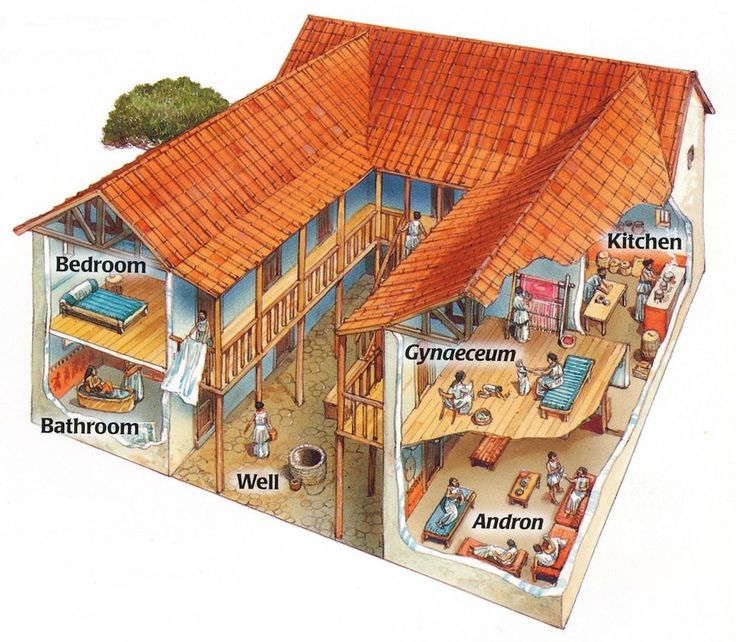
This is only partially the case. I instead, want you to think of the architecture of the home. Many ancient Greek homes were similar in that the house would have a second floor. In the classical Greek home, the second floor often looked up into the exposed slope of the rooftop. Many peoples in many places, have this kind of home.
Fig. 2 An Imagining of a Classical Greek Home
When I was very young my mother read the series of books written by Laura Ingalls wilder, a narrative of prairie life. I remember they had a home which had a second floor, more like an exposed attic, and a ladder which led up to it. This is where the children slept.
Fig. 3 Loft-style cabin late 19th century U.S. frontier
In the classical Greek home, the attic was not only the sleeping quarters, but also often referenced as the woman’s quarters. This is where the good Athenian wife would spend most of her day. As a result of the lack of sun, the good Attic wife had white arms, while the man was often depicted as dark or tan.
Fig. 4 From left to right: Hermes, Apollo, Zeus, Athena, Aphrodite, Ares. Men in black, women in white.
The good attic wife was not seen at the Marketplace, but she spent her time with her domestic slaves spinning thread, mainly from wool, and weaving fabric. She might go to a nearby rural spring to bring back water with her domestic slaves. Even the evil witch, Circe, in the Odyssey, was found weaving on her loom like a spider building a web, by rapidly weaving her thread back and forth across her loom. Circe’s magic, was pharmaceutical based, by the way, and so would be, the magic of a devious wife.
Fig. 5 Circe at her loom, Odysseus standing
Looking further at the architecture of the Classical Greek home you will see the standard outdoor courtyard(Fig.2). The good Attic wife could get plenty of air and light without being seen by other men. She would probably avoid too much sunlight if she wanted to maintain her white-armed appearance. Perhaps she would cover herself when necessary to avoid the burning gaze of Helios, another man by the way. The Roman’s did this with their famous Vestal Virgins. The lived behind highly secure walls in the symbolic center of the city. You could hear them sing and play from the outside, but you could not steal away their state assets. If you did, as you can guess, you would be executed.
Fig. 6 Vestal Virgins tend the immortal fire of the god Vesta
Within preserved Classical Greek court arguments we can see a Greek wife lure her lover to her own home when the husband was out of the house. This shows that it was perhaps less risky to have the secret lover visit the woman, rather than risk having the proper Attic wife seen roaming about the city unattended, which would be quite the red flag so to speak. I once won an ancient Greek style mock trial at the University of Missouri by making an argument, part of which explained why I would “honorably” visit local Athenian prostitutes rather than dirty myself with my enemy’s wife. You have to be a little familiar with the classical Athenian culture to understand why that argument would work.
The second floor as the woman’s quarters is highly significant for functional reasons. First, the man of the house could have other men visit the main floor, which also connected to the courtyard, and it was expected that all the females stay upstairs while another man visits. Historians, of course, do not believe this rule was absolute. Second, there are references to locks on the door which can prevent escape and access to the women’s quarters. In modern homes, we often have either multiple accesses to the second floor, or often a stairway which is open at the top and difficult to block off. Similarly, we often have a large yard, but our fences do not prevent penetration, nor conversation or eye contact between your non-Attic wife and a wandering man. The Classical Athenian man had the advantage of marrying, often in his 30s to a wife who was much younger.
Fig. 7 From "The Black Adder" Ep. 4 BBC 1983. The young Princess Leia of Hungary marries the much older Prince Blackadder.
It seems they wanted the “purity” of their wives safe and secure. Men often wanted many babies from their young wife, and this might bring her own death quite early. The Male Athenian citizen would then require a fresh Attic wife. An Attic wife would be expected to live among the children produced by her older husband and female slaves under the legally recognized institution of the man of the household breeding with one or more of his female slaves, which produced more slaves, not legitimate Athenian citizens. In retrospect, perhaps the wife of the household was an honorable enough position, and perhaps, it was better in some cases to not be the main target of her husband’s affections. You know with all the female slaves and legal prostitutes in the city proper to keep him busy. With some marriages, this might be helpful. Imagine, the husband comes home drunk and calls for his wife. The wife sends down a female slave… and goes back to bed.
---
[Video] "Good Greek Wives Stay in the Attic" Ancient Light #2 Live at SpoFest, Cafe Blackadder, Warrensburg, Missouri, U.S.
Today we ask what our gods can do for us. We compare promised afterlives, we pray for help for both major and minor things. In ancient times, there was more of a balance between what a god could do for a mortal, and what a mortal could do for a god. We all know about the original idea of sacrifice. One might sacrifice a delicious calf or cow. The Archaic Greeks would wrap the bones of the sacrifice with fat and give it to the gods, while the assembled people would eat the aforementioned delicious meat. Make no mistake, the significant ingredient to offer the god and/or gods was the blood. The fat and bones were secondary. Even Homer or Homer/s spoke about the great power of blood to the dead. It gave them a taste of life again.
Fig. 1 Apulian Red-Figure Krater 4th cent. BC detail
Today we talk of personal sacrifice and the only thing we give to our gods are things like prayer, the signing of hymns, and dedicating your own meal to a god. I’m not going to go as far as say a tithe goes to the benefit of a god, as much as it is a donation made in a gods name. Those are merely the most well-known examples of how the ancients strove to please their gods. In several cases, an ancient Greek literary figure would promise to make regular sacrifices to a particular god for some sort of payment for help or seeking penance for a committed crime. Odysseus attempted to keep the god of the sun from killing his men for eating his prize cattle. Odysseus tempted the sun god Helios with regular sacrifices once he makes it back to Ithaca, somewhere in New York [This is a joke BTW]]. It makes one wonder what god-like endorphin was triggered by a mere sacrifice of livestock. Perhaps, at the end of the day, all the gods added up the spilled blood, burnt offerings, small cakes, and winding smoke gained by each god. If that is the case, the ancient mortals were merely appealing to the ego of a particular god. The Classical Greek Gods are often portrayed like extremely powerful teenagers. From my exposure to Greek and Latin Classics, one thing is evident when it comes to the gods: you can actively set out to give an unknown benefit to a specific god, by making a sacrifice in his or her name. My favorite example is the Roman ‘Evocatio.’ A general of an army stops the troops outside the walls of a hostile city somewhere in Gaul or Asia Minor perhaps, and addresses the main god of the peoples therein. The general makes a sacrifice and calls out to the god of the city. But what does he say to the god? Modern ears, upon hearing this for the first time might guess that the general will call out to the local god and denounce him or her, comparing the lesser known god to the mighty Gods of Rome. This would not be the case. The Roman mentality was much different. They wanted to make Rome the spiritual center of the conquered world by bringing all the gods to it.
Fig. 2 "Evocation" Alexander Rothaug (1870 – 1946), Austrian
The Roman General proceeds to call the local god by name. He tells the god about Rome and how gods who move there experience much more glory and sacrificial gain then could be experienced in such a small city. The General then asks the god to abandon the temples of the hostile city and move to Rome. Of course, once the city was conquered, the people, one might assume, would be told where they can find their god. You know the phrase “all roads lead to Rome?” The roads are important, but what flows along those roads are much more than slaves, soldiers and trade. The moral of the prose: Ask not what your gods can do for you; rather, ask what you can do for your gods.
---
Ancient history themed podcast presented by Steve Dotson, history professor.
Recorded Live at Cafe Blackadder in Warrensburg, Missouri during the SpoFest spoken word event, April 1, 2016.
A satirical and informative look at Greek and Roman views of sacrifice to a god or gods.
Ancient Light #1 "Ask Not What Your Gods Can Do For You," Recorded Live, April 2016, Cafe Blackadder, Warrensburg, Missouri.
Hundreds of children's bones fill an ancient Athenian well. Some might immediately recall the use of infant exposure among the ancient Greeks. But wait, the bones in the well are filled with the bones of children of all ages, not merely newborns. Also, the bones of the children are mixed with the bones of dogs. How does this tell us this was unrelated to infant exposure? And, what does this tell us about ancient Greek ideas about dog sacrifice?
From the video: "The Myth of Er is a warning to maintain balance in life, much like the idea of the Middle Way of Buddhism. In conclusion, I am able to extract three rules from Plato’s telling of the myth. These rules will allow you to find balance in life, but more importantly to help you avoid eternity in Tartarus*. 1: Avoid the excesses of life, they lead to folly. This is the simplest form of moderation.
2: Avoid the one sidedness of assigning absolute qualities to things and people. Life is an inseparable mixture of what we consider good and evil.
3: Avoid the ignorance of underexposure: Those who go through life existing in a comfortable, infantile bubble are not developing the skills for the soul to find balance on its journey." *Tartarus: The depths of Hades where tyrants spend eternity in torment.
Video: "The Myth of Er" Ancient Light live, June 12, 2016
---
"Where do bad folks go when they die? They don't go to heaven where the angels fly. They go to a lake of fire and fry. Won't see 'em again 'till the Fourth of July."
A show about Plato's Forms and the Personification of human traits into a deity. Pictured above, the Statue of Liberty, given to the United States from France. I am in the process of writing an Ancient Light episode on "Lady Liberty" and her place in both ancient and modern history.
Mine Slave - The Dark Side of Ancient Light [Haiku & History]
Life in the light deny
Moving closer to Hades
Inching day by day
There were ancient slaves who were like family members, but there were slaves whose youth were wasted away in the mines, extracting precious metals, usually for a king or city, who often hire a contractor to supply the labor. This contractor could harness and hire large amounts of slaves for major projects. In many ways, the ancient world was built on the backs of slaves.
Fresh Slave - The Dark Side of Ancient Light [Haiku & History]
A pretty young thing
Last Seen wandering the coast
Father calls her name
Slavery could be a lucrative trade, even for those who do not specialize in it. One could kidnap a pretty girl and sell her for a pretty penny. The Greek classical tradition is filled with abduction scenes, often near the coast. Then again, ancient Greek life was hardly ever far from the sea. Those landlocked Arcadians might disagree.
Ancient History Prose & Satire - SpoFest Steve Dotson pt. 1 [11:16]
Introduction - Ancient Joke #1 - "Origin of a Flower" The story of the lovers Apollo & Hyacinthos - "Good Greek Wives Stay in the Attic" Satirical prose about the "Proper" Athenian wife.
Steve Dotson's 1st reading at SpoFest held at Café Blackadder April 1, 2016
Coward on the Front Line - The Dark Side of Ancient Light [Haiku & History]
Coward on the Front Line
Blamed for all their deaths
You could not hold the front line
How do you still live?
Most Greek hoplite warriors were farmers. Spartans were an exception, they lived in the barracks, professional full-time soldiers. The front line of the phalanx, and the entire unit, would be fellow landholders in one territory. You would be serving with your fellow countrymen, people you have known your whole life, your neighbors and relatives. In phalanx style combat, the front line must hold against the enemy to prevail in the initial stage of battle. To break a unit, is to crash the front line and divide the unit in to smaller parts to be picked off of who will retreat in disarray. It is then that the cavalry often chase those fleeing, or the battle for that war season was over as the enemy fled back home to prepare for the harvest season. If the front line doesn’t hold, and a member of the front is alive while everyone else dies, this might be met with suspicion.
Ancient Light Episode "Good Greek Wives Stay in the Attic" Ancient History & Classics
Ancient history themed podcast presented by Steve Dotson, history professor.
Recorded Live at Cafe Blackadder in Warrensburg, Missouri during a SpoFest spoken word event, April 1, 2016. Event photo courtesy of Faith Benson-Bemiss.