Exploring topics in History, Fiction, Mythology, & More
Upcoming Gothic Fiction Novel: Possessions of Putressa
Ancient Light on YouTube
Twitter @SteveDotson
[Lecture] Greek Reemergence from the Ancient Dark Age
Coming out of the ancient Dark Age and forming an identity
Quick Tour of Greece
Time Orientation: The Ancient Dark Ages [The Early Iron Age]
Anti-Monarchical Attitudes
Oligarchy, Tyranny, & Democracy [Demos + Kratos]
Spartan Mixed Government
Growth of Population & Trade. The Polis Concept.
The Phonetic Alphabet
Aristocratic Networks: Identity
Epic Tradition: Iliad & Odyssey
Tholos Tombs - Inventing a Past
Syncretism of Gods
Olympic Games & Other Games
Ancient Light Episode #5 Mixed Martial Arts vs Ancient Combat Sports
Episode five is Ancient Light's first long-form show. Host and historian, Steve Dotson presents a comparison of systems making up modern MMA and Systems which make up Ancient Pankration.
:33 Highlight of Modern MMA landscape 1:43 Evolution in modern MMA; "Rise of the kickers" Steve "Wonderboy" Thompson 3:20 Traditional martial arts (not ancient) & MMA 5:57 Main Argument; systems comparison 8:11 Modern boxing & heavy hands 10:00 Modern kicking systems: Muay Thai, TKD, Karate, Tournament style karate, kickboxing; Bill "Superfoot" Wallace; Steve "Wonderboy" Thompson 12:32 Modern Wrestling Systems 14:27 Submission systems 18:25 Specific systems: Muay Thai, Judo, modern athleticism, Chemical enhancement 26:45 Ancient unarmed combat systems; Boxing; Wrestling; Unmentioned Systems, [I will dedicate an entire episode to Prankration]; Athleticism: strength, unique training methods, lactic acid tolerance training example, chemical enhancement in the ancient world.
Topics mentioned in the show: MMA, UFC, Stephen "Wonderboy" Thompson, Conor McGregor, Rhonda Rousey, Muay Thai, Judo, Jiu Jitsu (Brazilian & Japanese), kickboxing, tae kwon do, karate, tournament fighting, submissions, boxing, wrestling, Greece, Roman-Greco, gladiators, combat, sports, olympic lifting, scientific training & conditioning, lactic acid tolerance, explosive strength, steroids, performance enhancing drugs, take-downs, athleticism, ancient Greek pottery, rear naked choke (hadaka jime), juji gatame (cross-body arm bar) (I call it a scissor arm lock in the show, but that is not the conventional term for it. Many commentators simply call it an arm bar).
I began this article during the 30 year anniversary of the game. I update this article occasionally with new visual themes & ideas.
A Beloved Video Game
At an age when video games tend to mean the most, I was a zealot of the so-called third generation of video games, one who played on 8-bit graphic consoles such as the Nintendo (NES) and Sega systems. The era produced hits such as 'Super Mario Brothers,' 'Zelda,' 'Contra,' and the original 'Sonic the Hedgehog.' I had a NES console. I spent the most time on Mario, 'Zelda,' 'Kung Fu,' 'Pro Wrestling,' 'Castlevania' and 'Dragon Warrior.' My favorite game in the 8-bit graphics world was 'Rygar.' It was set in an ancient mythological world. The hero, Rygar, was on a quest to destroy the leader of the dominant empire in order to restore peace to the land. Rygar had a flexible weapon which is somewhat similar to the type of weapon used by Simon Belmont from the game 'Castlevania.' The "Diskarmor" was a chain weapon with a shield at the end of the it, sometimes illustrated as more of a giant band saw.
Fig. 1 Rygar Arcade Flyer, Japan.
Like many games, the original version was first an arcade game, which usually had better graphics. Each console recreated the arcade game, each one taking on different aspects of the original game.
The Exercise
The visual themes of Rygar can serve as a fun exercise in assessing ancient themes. You should avoid ascribing intentions to the creators and designers of the game, and instead, think of this exercise as a game of dissecting an amalgamation and identifying the pieces.
The Discarmor
The discarmor was Rygar's main weapon. I can't think of an exact equivalent to this weapon in any cultural from any time-period. A shield that comes back to the user reminds one more of Captain America than some ancient hero like Herakles with his club, or Apollo with his bow.
The historical weapon (more like legendary) most similar to Rygar's discarmor, I think, is the flexible weapon which was thrown over the enemies head, as one pulled the cord, blades would open up inside the head bag and decapitate the one wearing it. This Chinese weapon is known in the west as the "Flying Guillotine."
Fig. A nice view of Rygar's discarmor in motion
Fig. The Flying Guillotine
The Diadem
The small crown was well known, especially seen on coins, in the ancient world. Alexander the Great wore a diadem with his mixed Persian and Greek garb.
The Persian King, Darius I. Behistun Inscription.
The Pants
Rygar is wearing pants. Why would this standout to an ancient historian? Greeks did not wear pants. As a matter of fact, they belittled cultures who wore the restrictive garments. The Greeks equated pant-wearing with the Persians. The "Other" wore pants.
The Shoes
In the assorted artwork related to Rygar, the shoe style is inconsistent. There is a lack of sandal and sandal style wraps in Rygar artwork, which indicate an ancient Greek ethnicity. Small shoes remind me of an ancient Persian item.
The Title
"Warrior of Argus." Argos? What heros in ancient Greek myth are from Argos? Perseus, for one.
Perseus
The Resurrected Warrior
In the Rygar story the hero is sometimes portrayed as a resurrected warrior. Other versions of the game has him as the new force taking over an old corrupt empire.
Along the way, the Hero of Rygar is aided by buff monks hidden inside caves and towers. These monks are seated in what looks like a classic meditation position reminiscent of Eastern Indian traditions. One sage even has a large third eye (Ajna), a staple of Indian religious systems.
If you had to choose, from what culture is the hero of the video game #Rygar? I will be talking about this on my podcast soon. Please leave your comments below. Feel free to explain your answer if you like.
Isn't the official story about a Greek hero that is resurrected to defeat evil? SEGA's Altered Beast has the same story BTW. I wonder if one of them stole the idea from the other?
From what I can find, the hero of Rygar is not mentioned as anything specific until the 2002 release, where he is intentionally Greek. It is possible the original makers intended the hero to be Greek, but the release from the late 80s (arcade and nes) shows imagery which is non-Greek. I don't want to give it away, I will be talking about it soon in my ancient history show. All in fun. Rygar was my all-time fav new game without a doubt.
Wanna know the true honest-to-the-gods origin of the Hyacinth flower? The flower is both beautiful and unique. The color comes from what looks more like clusters of delicate hanging bells – I usually see them in a deep blue or purple.
Fig. 1 The Hyacinth flower (Greek: ὑακίνθινος, "Hua-kin-thi-nos" meaning "blue")
Botanists and evolutionary biologists would tell you the genetic story of the plant, but here you will learn the true tale of the flower.
The eponymous demi-god, Hyacinthos, was the son of the goddess and the famous muse Klio and a king (the name changes depending on the version of the tale). The god Apollo, the great archer, soothsayer, whose symbol is often the sun, was his lover. Since, apparently, Hyacinthos was popular within the ancient LGBTQ community, he had other male lovers as well. One such beloved was the West Wind (Zephyr), who was jealous of the love between Hyacinthos and Apollo. In Amyclae, South of Sparta, was laid a statue of Apollo and Hyacinthos, most likely a “hometown” region from whence came the legend involving Hyacinthos.
Fig. 2 The Greek region of Lakonia the location of the towns of Sparta and Amyclae
The legends tell us that one day in Amyclae, Apollo and Hyacinthus were showing off their discus skills. Apollo, of course, must have had an amazing throw – the heavy disc must have hung in the air for an impressive amount of time. Ancient Greeks, when they saw a disc floating through the air, perhaps did not immediately think it was an alien aircraft like we do today, but that perhaps Apollo was practicing discus on the other side of the hill. It is said the West Wind saw a great opportunity in this moment. Now, I have never had a problem with the West Wind, and I mean no disrespect, I would not want to anger any of the wind family. I sometimes play disc golf, where one attempts to throw a lightweight disc 300 feet or so into a basket. It is like playing Frisbee, but with no friend to catch it and throw it back. A game where things like trees and wind often determine one’s fate.
Fig. 3 Apollo embraces the slain Hyacinthos. The disc can be seen on the ground. Do you see Zephyr the West Wind?
It is at this time the West Wind is blamed for directing the disc, as it sailed through the air, into the skull of Hyacinthos, which promptly split open and spilled its contents onto the hillside. It is there where the Hyacinth flower first arose. Local priests of the Hyacinthos cult probably propagated the flower species within their temple grounds (temenos).
1876 Antique Botanical Print Hyacinth Purple Flower Plate Van Houtte
As a final note: One can only imagine the vast number of times the tragic story was retold to a youth as strollers walked past a patch of Hyacinth. You too, now, when you see the flower, might remind yourself of a homoerotic love triangle gone badly, and the demi-god who had his brains spilled for your landscaping pleasure.
---
[Video] "Origin of a Flower" Ancient Light #3 live at SpoFest, Cafe Blackadder, Warrensburg, Mo., April 1, 2016.
With the title “Good Greek Wives Stay in the Attic” someone familiar with classical scholarship or ancient geography might think I am making a joke by referencing the attic, as an allusion to the area of Attika, the region which contained the great city of Athens.
Fig. 1 The region of Attica.
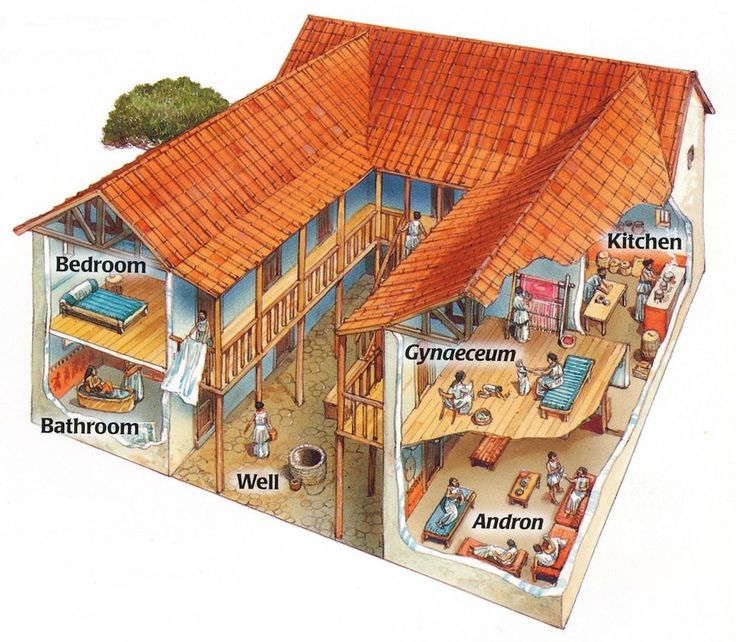
This is only partially the case. I instead, want you to think of the architecture of the home. Many ancient Greek homes were similar in that the house would have a second floor. In the classical Greek home, the second floor often looked up into the exposed slope of the rooftop. Many peoples in many places, have this kind of home.
Fig. 2 An Imagining of a Classical Greek Home
When I was very young my mother read the series of books written by Laura Ingalls wilder, a narrative of prairie life. I remember they had a home which had a second floor, more like an exposed attic, and a ladder which led up to it. This is where the children slept.
Fig. 3 Loft-style cabin late 19th century U.S. frontier
In the classical Greek home, the attic was not only the sleeping quarters, but also often referenced as the woman’s quarters. This is where the good Athenian wife would spend most of her day. As a result of the lack of sun, the good Attic wife had white arms, while the man was often depicted as dark or tan.
Fig. 4 From left to right: Hermes, Apollo, Zeus, Athena, Aphrodite, Ares. Men in black, women in white.
The good attic wife was not seen at the Marketplace, but she spent her time with her domestic slaves spinning thread, mainly from wool, and weaving fabric. She might go to a nearby rural spring to bring back water with her domestic slaves. Even the evil witch, Circe, in the Odyssey, was found weaving on her loom like a spider building a web, by rapidly weaving her thread back and forth across her loom. Circe’s magic, was pharmaceutical based, by the way, and so would be, the magic of a devious wife.
Fig. 5 Circe at her loom, Odysseus standing
Looking further at the architecture of the Classical Greek home you will see the standard outdoor courtyard(Fig.2). The good Attic wife could get plenty of air and light without being seen by other men. She would probably avoid too much sunlight if she wanted to maintain her white-armed appearance. Perhaps she would cover herself when necessary to avoid the burning gaze of Helios, another man by the way. The Roman’s did this with their famous Vestal Virgins. The lived behind highly secure walls in the symbolic center of the city. You could hear them sing and play from the outside, but you could not steal away their state assets. If you did, as you can guess, you would be executed.
Fig. 6 Vestal Virgins tend the immortal fire of the god Vesta
Within preserved Classical Greek court arguments we can see a Greek wife lure her lover to her own home when the husband was out of the house. This shows that it was perhaps less risky to have the secret lover visit the woman, rather than risk having the proper Attic wife seen roaming about the city unattended, which would be quite the red flag so to speak. I once won an ancient Greek style mock trial at the University of Missouri by making an argument, part of which explained why I would “honorably” visit local Athenian prostitutes rather than dirty myself with my enemy’s wife. You have to be a little familiar with the classical Athenian culture to understand why that argument would work.
The second floor as the woman’s quarters is highly significant for functional reasons. First, the man of the house could have other men visit the main floor, which also connected to the courtyard, and it was expected that all the females stay upstairs while another man visits. Historians, of course, do not believe this rule was absolute. Second, there are references to locks on the door which can prevent escape and access to the women’s quarters. In modern homes, we often have either multiple accesses to the second floor, or often a stairway which is open at the top and difficult to block off. Similarly, we often have a large yard, but our fences do not prevent penetration, nor conversation or eye contact between your non-Attic wife and a wandering man. The Classical Athenian man had the advantage of marrying, often in his 30s to a wife who was much younger.
Fig. 7 From "The Black Adder" Ep. 4 BBC 1983. The young Princess Leia of Hungary marries the much older Prince Blackadder.
It seems they wanted the “purity” of their wives safe and secure. Men often wanted many babies from their young wife, and this might bring her own death quite early. The Male Athenian citizen would then require a fresh Attic wife. An Attic wife would be expected to live among the children produced by her older husband and female slaves under the legally recognized institution of the man of the household breeding with one or more of his female slaves, which produced more slaves, not legitimate Athenian citizens. In retrospect, perhaps the wife of the household was an honorable enough position, and perhaps, it was better in some cases to not be the main target of her husband’s affections. You know with all the female slaves and legal prostitutes in the city proper to keep him busy. With some marriages, this might be helpful. Imagine, the husband comes home drunk and calls for his wife. The wife sends down a female slave… and goes back to bed.
---
[Video] "Good Greek Wives Stay in the Attic" Ancient Light #2 Live at SpoFest, Cafe Blackadder, Warrensburg, Missouri, U.S.


 SteveDotson