Exploring topics in History, Fiction, Mythology, & More
Upcoming Gothic Fiction Novel: Possessions of Putressa
Ancient Light on YouTube
Twitter @SteveDotson
Ancient Light Episode #5 Mixed Martial Arts vs Ancient Combat Sports
Episode five is Ancient Light's first long-form show. Host and historian, Steve Dotson presents a comparison of systems making up modern MMA and Systems which make up Ancient Pankration.
:33 Highlight of Modern MMA landscape 1:43 Evolution in modern MMA; "Rise of the kickers" Steve "Wonderboy" Thompson 3:20 Traditional martial arts (not ancient) & MMA 5:57 Main Argument; systems comparison 8:11 Modern boxing & heavy hands 10:00 Modern kicking systems: Muay Thai, TKD, Karate, Tournament style karate, kickboxing; Bill "Superfoot" Wallace; Steve "Wonderboy" Thompson 12:32 Modern Wrestling Systems 14:27 Submission systems 18:25 Specific systems: Muay Thai, Judo, modern athleticism, Chemical enhancement 26:45 Ancient unarmed combat systems; Boxing; Wrestling; Unmentioned Systems, [I will dedicate an entire episode to Prankration]; Athleticism: strength, unique training methods, lactic acid tolerance training example, chemical enhancement in the ancient world.
Topics mentioned in the show: MMA, UFC, Stephen "Wonderboy" Thompson, Conor McGregor, Rhonda Rousey, Muay Thai, Judo, Jiu Jitsu (Brazilian & Japanese), kickboxing, tae kwon do, karate, tournament fighting, submissions, boxing, wrestling, Greece, Roman-Greco, gladiators, combat, sports, olympic lifting, scientific training & conditioning, lactic acid tolerance, explosive strength, steroids, performance enhancing drugs, take-downs, athleticism, ancient Greek pottery, rear naked choke (hadaka jime), juji gatame (cross-body arm bar) (I call it a scissor arm lock in the show, but that is not the conventional term for it. Many commentators simply call it an arm bar).
In my studies if the Greek version of the Assyrian Queen Semiramis, I quickly found that most of her military exploits were simply borrowings from tales of Alexander the Great. I made a close study of Alexander’s recurring use of emulation and imitation of mythical gods and conquerors. I spent two years studying the Macedonian king in detail alongside other academic pursuits. There is my exposure to the histories and myths of Alexander the Great.
Fig. 1 Alexander the Great
As for drag queens, my exposure is decent enough. In my 20s I spent part of my time as a videographer. A friend told me the local gay bar was looking for someone to film their big Saturday event “Divas by Design.” So, for about two years I spent many Saturday nights filming drag queen monologues and lip sync performances. Those ladies were more on the professional end of the drag queen spectrum, it was not amateur night. At first the bar manager paid me in drinks. Eventually, he decided to pay in cash. Probably for good reason. I like cash more than long island iced teas, so this worked out nicely. Those were some fun times. I heard from at least two of the performers that they loved my camera work. This is what I did. Around the entire club and around the bar are these television screens, both large and small, which project everything I filmed. If you are consistently bad at panning and have a hard time finding nice appealing frames to display the action, then your bad work will be displayed on every wall and in various spots around the bar. I was good at filming the action, but the biggest problem was the time between performances, where all you are doing is filming the curtain. I quickly came up with tasteful shots for the ubiquitous monitors all over the club as everyone waited for the next performance, looking up from their drinks. One trick, I learned to zoom into the shiny spinning mirror ball, which would create an awesome effect throughout the room as the glare and glean of the disco ball shines brightly through every monitor. The trick the performers liked was when I would capture a great close up of the performer, or during a well framed pose and save it as a photograph or what videographers often call a still frame. As the drag queen would leave the stage I would fade up the still frame photo image. The audience would see the last performer on the screen instead of an empty stage. This helped showcase the last performer and gave my product a professional edge. The girls had tv monitors in the changing room, and raved about the still frame I would fade up as the performer disappeared off the stage. There you have it two years studying Alexander the Great and two years observing the drag queen arts.
Fig. 2 Meme for Ancient Light episode #4
One might ask, who was history's first drag queen? The answer is, we will never know. One might think British comedians have a monopoly on the art in comedy, but we must look further.
Fig. 3 "Little Britain" David Walliams as Phyllis, with her spaniel, Mr. Doggy
Alexander the Great, I found, would dress up as various gods and heroes while hanging out with his friends. We would dress like Herakles (The Romans called him Hercules), you know the lion-head helmet, the tiger fur strapped around one shoulder and a big wooden club in his hand. What is realized, when reading the list of gods who were subject to Alexander’s imitation is that Alexander dressed up like Artemis. Artemis, as you might know is the sister of Apollo. She is often considered the protector of little girls and small animals. Alexander would dress up like her and ride a chariot shooting arrows. On classical pottery she is pictured with her skirt and bow. Sometimes she has a long woman’s robe, or female style breastplate armor.
Fig. 4 Artemis, sister of Apollo, protector of children and young animals. She is an expert with the bow.
One soon realizes that one of the greatest known conquerors of the ancient world, would indeed, fit the modern definition of a drag queen. Alexander was a man who dressed up like a woman while performing for an audience. Historians have been questioning Alexander’s more intimate orientations, but dressing up as Artemis is hardly the biggest red flag. Alternatively, not all drag queens are what you think. Some of them have wives at home, they just like to get really drunk and dance around in women’s clothes. This has some similarity with Alexander the Great. For example, Alexander was a Member of the Macedonian elite. The drunken and bawdy Greeks themselves considered the Macedonians in the North to be outrageous drinkers who consumed unmixed wine. While it has yet to be determined, I would venture to guess, that if the drag queen arts were to fall under the realm of one of the Olympian gods it would be the god of wine and dancing women, a favorite of Alexander and the Macedonian elite in particular, Dionysus. Alexander, in retrospect, would simply have been an earnest devotee of his god, as heavy intoxication was often equated with the invocation of the God of Wine. In conclusion, we do not know exactly everything that is implied when we read about Alexander the Great playing the role of a Drag Queen, we only know he must have been really great at it.
Wanna know the true honest-to-the-gods origin of the Hyacinth flower? The flower is both beautiful and unique. The color comes from what looks more like clusters of delicate hanging bells – I usually see them in a deep blue or purple.
Fig. 1 The Hyacinth flower (Greek: ὑακίνθινος, "Hua-kin-thi-nos" meaning "blue")
Botanists and evolutionary biologists would tell you the genetic story of the plant, but here you will learn the true tale of the flower.
The eponymous demi-god, Hyacinthos, was the son of the goddess and the famous muse Klio and a king (the name changes depending on the version of the tale). The god Apollo, the great archer, soothsayer, whose symbol is often the sun, was his lover. Since, apparently, Hyacinthos was popular within the ancient LGBTQ community, he had other male lovers as well. One such beloved was the West Wind (Zephyr), who was jealous of the love between Hyacinthos and Apollo. In Amyclae, South of Sparta, was laid a statue of Apollo and Hyacinthos, most likely a “hometown” region from whence came the legend involving Hyacinthos.
Fig. 2 The Greek region of Lakonia the location of the towns of Sparta and Amyclae
The legends tell us that one day in Amyclae, Apollo and Hyacinthus were showing off their discus skills. Apollo, of course, must have had an amazing throw – the heavy disc must have hung in the air for an impressive amount of time. Ancient Greeks, when they saw a disc floating through the air, perhaps did not immediately think it was an alien aircraft like we do today, but that perhaps Apollo was practicing discus on the other side of the hill. It is said the West Wind saw a great opportunity in this moment. Now, I have never had a problem with the West Wind, and I mean no disrespect, I would not want to anger any of the wind family. I sometimes play disc golf, where one attempts to throw a lightweight disc 300 feet or so into a basket. It is like playing Frisbee, but with no friend to catch it and throw it back. A game where things like trees and wind often determine one’s fate.
Fig. 3 Apollo embraces the slain Hyacinthos. The disc can be seen on the ground. Do you see Zephyr the West Wind?
It is at this time the West Wind is blamed for directing the disc, as it sailed through the air, into the skull of Hyacinthos, which promptly split open and spilled its contents onto the hillside. It is there where the Hyacinth flower first arose. Local priests of the Hyacinthos cult probably propagated the flower species within their temple grounds (temenos).
1876 Antique Botanical Print Hyacinth Purple Flower Plate Van Houtte
As a final note: One can only imagine the vast number of times the tragic story was retold to a youth as strollers walked past a patch of Hyacinth. You too, now, when you see the flower, might remind yourself of a homoerotic love triangle gone badly, and the demi-god who had his brains spilled for your landscaping pleasure.
---
[Video] "Origin of a Flower" Ancient Light #3 live at SpoFest, Cafe Blackadder, Warrensburg, Mo., April 1, 2016.
With the title “Good Greek Wives Stay in the Attic” someone familiar with classical scholarship or ancient geography might think I am making a joke by referencing the attic, as an allusion to the area of Attika, the region which contained the great city of Athens.
Fig. 1 The region of Attica.
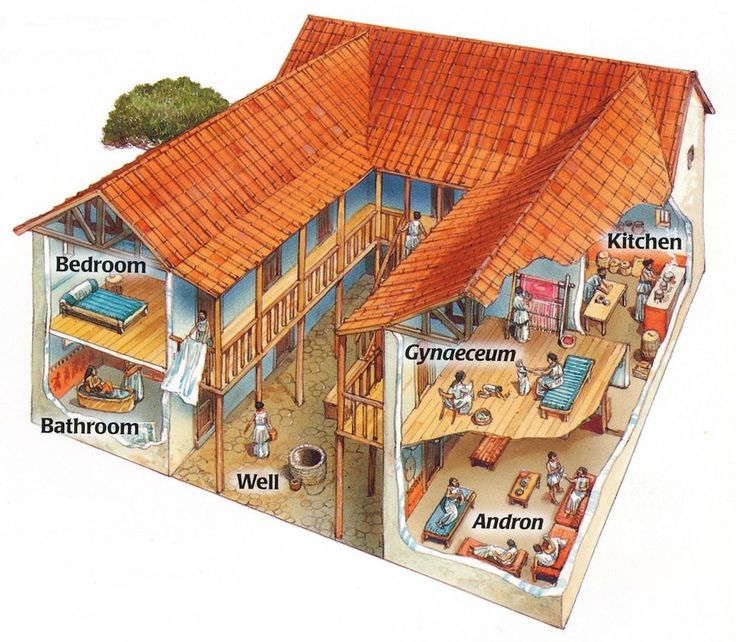
This is only partially the case. I instead, want you to think of the architecture of the home. Many ancient Greek homes were similar in that the house would have a second floor. In the classical Greek home, the second floor often looked up into the exposed slope of the rooftop. Many peoples in many places, have this kind of home.
Fig. 2 An Imagining of a Classical Greek Home
When I was very young my mother read the series of books written by Laura Ingalls wilder, a narrative of prairie life. I remember they had a home which had a second floor, more like an exposed attic, and a ladder which led up to it. This is where the children slept.
Fig. 3 Loft-style cabin late 19th century U.S. frontier
In the classical Greek home, the attic was not only the sleeping quarters, but also often referenced as the woman’s quarters. This is where the good Athenian wife would spend most of her day. As a result of the lack of sun, the good Attic wife had white arms, while the man was often depicted as dark or tan.
Fig. 4 From left to right: Hermes, Apollo, Zeus, Athena, Aphrodite, Ares. Men in black, women in white.
The good attic wife was not seen at the Marketplace, but she spent her time with her domestic slaves spinning thread, mainly from wool, and weaving fabric. She might go to a nearby rural spring to bring back water with her domestic slaves. Even the evil witch, Circe, in the Odyssey, was found weaving on her loom like a spider building a web, by rapidly weaving her thread back and forth across her loom. Circe’s magic, was pharmaceutical based, by the way, and so would be, the magic of a devious wife.
Fig. 5 Circe at her loom, Odysseus standing
Looking further at the architecture of the Classical Greek home you will see the standard outdoor courtyard(Fig.2). The good Attic wife could get plenty of air and light without being seen by other men. She would probably avoid too much sunlight if she wanted to maintain her white-armed appearance. Perhaps she would cover herself when necessary to avoid the burning gaze of Helios, another man by the way. The Roman’s did this with their famous Vestal Virgins. The lived behind highly secure walls in the symbolic center of the city. You could hear them sing and play from the outside, but you could not steal away their state assets. If you did, as you can guess, you would be executed.
Fig. 6 Vestal Virgins tend the immortal fire of the god Vesta
Within preserved Classical Greek court arguments we can see a Greek wife lure her lover to her own home when the husband was out of the house. This shows that it was perhaps less risky to have the secret lover visit the woman, rather than risk having the proper Attic wife seen roaming about the city unattended, which would be quite the red flag so to speak. I once won an ancient Greek style mock trial at the University of Missouri by making an argument, part of which explained why I would “honorably” visit local Athenian prostitutes rather than dirty myself with my enemy’s wife. You have to be a little familiar with the classical Athenian culture to understand why that argument would work.
The second floor as the woman’s quarters is highly significant for functional reasons. First, the man of the house could have other men visit the main floor, which also connected to the courtyard, and it was expected that all the females stay upstairs while another man visits. Historians, of course, do not believe this rule was absolute. Second, there are references to locks on the door which can prevent escape and access to the women’s quarters. In modern homes, we often have either multiple accesses to the second floor, or often a stairway which is open at the top and difficult to block off. Similarly, we often have a large yard, but our fences do not prevent penetration, nor conversation or eye contact between your non-Attic wife and a wandering man. The Classical Athenian man had the advantage of marrying, often in his 30s to a wife who was much younger.
Fig. 7 From "The Black Adder" Ep. 4 BBC 1983. The young Princess Leia of Hungary marries the much older Prince Blackadder.
It seems they wanted the “purity” of their wives safe and secure. Men often wanted many babies from their young wife, and this might bring her own death quite early. The Male Athenian citizen would then require a fresh Attic wife. An Attic wife would be expected to live among the children produced by her older husband and female slaves under the legally recognized institution of the man of the household breeding with one or more of his female slaves, which produced more slaves, not legitimate Athenian citizens. In retrospect, perhaps the wife of the household was an honorable enough position, and perhaps, it was better in some cases to not be the main target of her husband’s affections. You know with all the female slaves and legal prostitutes in the city proper to keep him busy. With some marriages, this might be helpful. Imagine, the husband comes home drunk and calls for his wife. The wife sends down a female slave… and goes back to bed.
---
[Video] "Good Greek Wives Stay in the Attic" Ancient Light #2 Live at SpoFest, Cafe Blackadder, Warrensburg, Missouri, U.S.
Today we ask what our gods can do for us. We compare promised afterlives, we pray for help for both major and minor things. In ancient times, there was more of a balance between what a god could do for a mortal, and what a mortal could do for a god. We all know about the original idea of sacrifice. One might sacrifice a delicious calf or cow. The Archaic Greeks would wrap the bones of the sacrifice with fat and give it to the gods, while the assembled people would eat the aforementioned delicious meat. Make no mistake, the significant ingredient to offer the god and/or gods was the blood. The fat and bones were secondary. Even Homer or Homer/s spoke about the great power of blood to the dead. It gave them a taste of life again.
Fig. 1 Apulian Red-Figure Krater 4th cent. BC detail
Today we talk of personal sacrifice and the only thing we give to our gods are things like prayer, the signing of hymns, and dedicating your own meal to a god. I’m not going to go as far as say a tithe goes to the benefit of a god, as much as it is a donation made in a gods name. Those are merely the most well-known examples of how the ancients strove to please their gods. In several cases, an ancient Greek literary figure would promise to make regular sacrifices to a particular god for some sort of payment for help or seeking penance for a committed crime. Odysseus attempted to keep the god of the sun from killing his men for eating his prize cattle. Odysseus tempted the sun god Helios with regular sacrifices once he makes it back to Ithaca, somewhere in New York [This is a joke BTW]]. It makes one wonder what god-like endorphin was triggered by a mere sacrifice of livestock. Perhaps, at the end of the day, all the gods added up the spilled blood, burnt offerings, small cakes, and winding smoke gained by each god. If that is the case, the ancient mortals were merely appealing to the ego of a particular god. The Classical Greek Gods are often portrayed like extremely powerful teenagers. From my exposure to Greek and Latin Classics, one thing is evident when it comes to the gods: you can actively set out to give an unknown benefit to a specific god, by making a sacrifice in his or her name. My favorite example is the Roman ‘Evocatio.’ A general of an army stops the troops outside the walls of a hostile city somewhere in Gaul or Asia Minor perhaps, and addresses the main god of the peoples therein. The general makes a sacrifice and calls out to the god of the city. But what does he say to the god? Modern ears, upon hearing this for the first time might guess that the general will call out to the local god and denounce him or her, comparing the lesser known god to the mighty Gods of Rome. This would not be the case. The Roman mentality was much different. They wanted to make Rome the spiritual center of the conquered world by bringing all the gods to it.
Fig. 2 "Evocation" Alexander Rothaug (1870 – 1946), Austrian
The Roman General proceeds to call the local god by name. He tells the god about Rome and how gods who move there experience much more glory and sacrificial gain then could be experienced in such a small city. The General then asks the god to abandon the temples of the hostile city and move to Rome. Of course, once the city was conquered, the people, one might assume, would be told where they can find their god. You know the phrase “all roads lead to Rome?” The roads are important, but what flows along those roads are much more than slaves, soldiers and trade. The moral of the prose: Ask not what your gods can do for you; rather, ask what you can do for your gods.
---
Ancient history themed podcast presented by Steve Dotson, history professor.
Recorded Live at Cafe Blackadder in Warrensburg, Missouri during the SpoFest spoken word event, April 1, 2016.
A satirical and informative look at Greek and Roman views of sacrifice to a god or gods.
Ancient Light #1 "Ask Not What Your Gods Can Do For You," Recorded Live, April 2016, Cafe Blackadder, Warrensburg, Missouri.
Plato Republic, Book X 614-621.Translation by Benjamin Jowett
Well, I said, I will tell you a tale; not one of the tales which Odysseus tells to the hero Alcinous, yet this too is a tale of a hero, Er the son of Armenius, a Pamphylian by birth. He was slain in battle, and ten days afterwards, when the bodies of the dead were taken up already in a state of corruption, his body was found unaffected by decay, and carried away home to be buried.
And on the twelfth day, as he was lying on the funeral pile, he returned to life and told them what he had seen in the other world. He said that when his soul left the body he went on a journey with a great company, and that they came to a mysterious place at which there were two openings in the earth; they were near together, and over against them were two other openings in the heaven above.
In the intermediate space there were judges seated, who commanded the just, after they had given judgment on them and had bound their sentences in front of them, to ascend by the heavenly way on the right hand; and in like manner the unjust were bidden by them to descend by the lower way on the left hand; these also bore the symbols of their deeds, but fastened on their backs. He drew near, and they told him that he was to be the messenger who would carry the report of the other world to men, and they bade him hear and see all that was to be heard and seen in that place. Then he beheld and saw on one side the souls departing at either opening of heaven and earth when sentence had been given on them; and at the two other openings other souls, some ascending out of the earth dusty and worn with travel, some descending out of heaven clean and bright.
And they told one another of what had happened by the way, those from below weeping and sorrowing at the remembrance of the things which they had endured and seen in their journey beneath the earth (now the journey lasted a thousand years), while those from above were describing heavenly delights and visions of inconceivable beauty. The story, Glaucon, would take too long to tell; but the sum was this:—He said that for every wrong which they had done to any one they suffered tenfold; or once in a hundred years—such being reckoned to be the length of man's life, and the penalty being thus paid ten times in a thousand years. If, for example, there were any who had been the cause of many deaths, or had betrayed or enslaved cities or armies, or been guilty of any other evil behaviour, for each and all of their offences they received punishment ten times over, and the rewards of beneficence and justice and holiness were in the same proportion. I need hardly repeat what he said concerning young children dying almost as soon as they were born. Of piety and impiety to gods and parents, and of murderers, there were retributions other and greater far which he described. He mentioned that he was present when one of the spirits asked another, 'Where is Ardiaeus the Great?' (Now this Ardiaeus lived a thousand years before the time of Er: he had been the tyrant of some city of Pamphylia, and had murdered his aged father and his elder brother, and was said to have committed many other abominable crimes.) The answer of the other spirit was: 'He comes not hither and will never come. And this,' said he, 'was one of the dreadful sights which we ourselves witnessed. We were at the mouth of the cavern, and, having completed all our experiences, were about to reascend, when of a sudden Ardiaeus appeared and several others, most of whom were tyrants; and there were also besides the tyrants private individuals who had been great criminals: they were just, as they fancied, about to return into the upper world, but the mouth, instead of admitting them, gave a roar, whenever any of these incurable sinners or some one who had not been sufficiently punished tried to ascend; and then wild men of fiery aspect, who were standing by and heard the sound, seized and carried them off; and Ardiaeus and others they bound head and foot and hand, and threw them down and flayed them with scourges, and dragged them along the road at the side, carding them on thorns like wool, and declaring to the passers-by what were their crimes, and that they were being taken away to be cast into hell.' And of all the many terrors which they had endured, he said that there was none like the terror which each of them felt at that moment, lest they should hear the voice; and when there was silence, one by one they ascended with exceeding joy. These, said Er, were the penalties and retributions, and there were blessings as great.And arriving ever and anon they seemed to have come from a long journey, and they went forth with gladness into the meadow, where they encamped as at a festival; and those who knew one another embraced and conversed, the souls which came from earth curiously enquiring about the things above, and the souls which came from heaven about the things beneath.
Now when the spirits which were in the meadow had tarried seven days, on the eighth they were obliged to proceed on their journey, and, on the fourth day after, he said that they came to a place where they could see from above a line of light, straight as a column, extending right through the whole heaven and through the earth, in colour resembling the rainbow, only brighter and purer; another day's journey brought them to the place, and there, in the midst of the light, they saw the ends of the chains of heaven let down from above: for this light is the belt of heaven, and holds together the circle of the universe, like the under-girders of a trireme. From these ends is extended the spindle of Necessity, on which all the revolutions turn. The shaft and hook of this spindle are made of steel, and the whorl is made partly of steel and also partly of other materials. Now the whorl is in form like the whorl used on earth; and the description of it implied that there is one large hollow whorl which is quite scooped out, and into this is fitted another lesser one, and another, and another, and four others, making eight in all, like vessels which fit into one another; the whorls show their edges on the upper side, and on their lower side all together form one continuous whorl. This is pierced by the spindle, which is driven home through the centre of the eighth. The first and outermost whorl has the rim broadest, and the seven inner whorls are narrower, in the following proportions—the sixth is next to the first in size, the fourth next to the sixth; then comes the eighth; the seventh is fifth, the fifth is sixth, the third is seventh, last and eighth comes the second. The largest (or fixed stars) is spangled, and the seventh (or sun) is brightest; the eighth (or moon) coloured by the reflected light of the seventh; the second and fifth (Saturn and Mercury) are in colour like one another, and yellower than the preceding; the third (Venus) has the whitest light; the fourth (Mars) is reddish; the sixth (Jupiter) is in whiteness second. Now the whole spindle has the same motion; but, as the whole revolves in one direction, the seven inner circles move slowly in the other, and of these the swiftest is the eighth; next in swiftness are the seventh, sixth, and fifth, which move together; third in swiftness appeared to move according to the law of this reversed motion the fourth; the third appeared fourth and the second fifth. The spindle turns on the knees of Necessity; and on the upper surface of each circle is a siren, who goes round with them, hymning a single tone or note. The eight together form one harmony; and round about, at equal intervals, there is another band, three in number, each sitting upon her throne: these are the Fates, daughters of Necessity, who are clothed in white robes and have chaplets upon their heads, Lachesis and Clotho and Atropos, who accompany with their voices the harmony of the sirens—Lachesis singing of the past, Clotho of the present, Atropos of the future; Clotho from time to time assisting with a touch of her right hand the revolution of the outer circle of the whorl or spindle, and Atropos with her left hand touching and guiding the inner ones, and Lachesis laying hold of either in turn, first with one hand and then with the other.
When Er and the spirits arrived, their duty was to go at once to Lachesis; but first of all there came a prophet who arranged them in order; then he took from the knees of Lachesis lots and samples of lives, and having mounted a high pulpit, spoke as follows: 'Hear the word of Lachesis, the daughter of Necessity. Mortal souls, behold a new cycle of life and mortality. Your genius will not be allotted to you, but you will choose your genius; and let him who draws the first lot have the first choice, and the life which he chooses shall be his destiny. Virtue is free, and as a man honours or dishonours her he will have more or less of her; the responsibility is with the chooser—God is justified.' When the Interpreter had thus spoken he scattered lots indifferently among them all, and each of them took up the lot which fell near him, all but Er himself (he was not allowed), and each as he took his lot perceived the number which he had obtained. Then the Interpreter placed on the ground before them the samples of lives; and there were many more lives than the souls present, and they were of all sorts. There were lives of every animal and of man in every condition. And there were tyrannies among them, some lasting out the tyrant's life, others which broke off in the middle and came to an end in poverty and exile and beggary; and there were lives of famous men, some who were famous for their form and beauty as well as for their strength and success in games, or, again, for their birth and the qualities of their ancestors; and some who were the reverse of famous for the opposite qualities. And of women likewise; there was not, however, any definite character in them, because the soul, when choosing a new life, must of necessity become different. But there was every other quality, and the all mingled with one another, and also with elements of wealth and poverty, and disease and health; and there were mean states also. And here, my dear Glaucon, is the supreme peril of our human state; and therefore the utmost care should be taken. Let each one of us leave every other kind of knowledge and seek and follow one thing only, if peradventure he may be able to learn and may find some one who will make him able to learn and discern between good and evil, and so to choose always and everywhere the better life as he has opportunity. He should consider the bearing of all these things which have been mentioned severally and collectively upon virtue; he should know what the effect of beauty is when combined with poverty or wealth in a particular soul, and what are the good and evil consequences of noble and humble birth, of private and public station, of strength and weakness, of cleverness and dullness, and of all the natural and acquired gifts of the soul, and the operation of them when conjoined; he will then look at the nature of the soul, and from the consideration of all these qualities he will be able to determine which is the better and which is the worse; and so he will choose, giving the name of evil to the life which will make his soul more unjust, and good to the life which will make his soul more just; all else he will disregard. For we have seen and know that this is the best choice both in life and after death. A man must take with him into the world below an adamantine faith in truth and right, that there too he may be undazzled by the desire of wealth or the other allurements of evil, lest, coming upon tyrannies and similar villainies, he do irremediable wrongs to others and suffer yet worse himself; but let him know how to choose the mean and avoid the extremes on either side, as far as possible, not only in this life but in all that which is to come. For this is the way of happiness.
And according to the report of the messenger from the other world this was what the prophet said at the time: 'Even for the last comer, if he chooses wisely and will live diligently, there is appointed a happy and not undesirable existence. Let not him who chooses first be careless, and let not the last despair.' And when he had spoken, he who had the first choice came forward and in a moment chose the greatest tyranny; his mind having been darkened by folly and sensuality, he had not thought out the whole matter before he chose, and did not at first sight perceive that he was fated, among other evils, to devour his own children. But when he had time to reflect, and saw what was in the lot, he began to beat his breast and lament over his choice, forgetting the proclamation of the prophet; for, instead of throwing the blame of his misfortune on himself, he accused chance and the gods, and everything rather than himself. Now he was one of those who came from heaven, and in a former life had dwelt in a well-ordered State, but his virtue was a matter of habit only, and he had no philosophy. And it was true of others who were similarly overtaken, that the greater number of them came from heaven and therefore they had never been schooled by trial, whereas the pilgrims who came from earth having themselves suffered and seen others suffer, were not in a hurry to choose. And owing to this inexperience of theirs, and also because the lot was a chance, many of the souls exchanged a good destiny for an evil or an evil for a good. For if a man had always on his arrival in this world dedicated himself from the first to sound philosophy, and had been moderately fortunate in the number of the lot, he might, as the messenger reported, be happy here, and also his journey to another life and return to this, instead of being rough and underground, would be smooth and heavenly. Most curious, he said, was the spectacle—sad and laughable and strange; for the choice of the souls was in most cases based on their experience of a previous life. There he saw the soul which had once been Orpheus choosing the life of a swan out of enmity to the race of women, hating to be born of a woman because they had been his murderers; he beheld also the soul of Thamyras choosing the life of a nightingale; birds, on the other hand, like the swan and other musicians, wanting to be men. The soul which obtained the twentieth lot chose the life of a lion, and this was the soul of Ajax the son of Telamon, who would not be a man, remembering the injustice which was done him in the judgment about the arms. The next was Agamemnon, who took the life of an eagle, because, like Ajax, he hated human nature by reason of his sufferings. About the middle came the lot of Atalanta; she, seeing the great fame of an athlete, was unable to resist the temptation: and after her there followed the soul of Epeus the son of Panopeus passing into the nature of a woman cunning in the arts; and far away among the last who chose, the soul of the jester Thersites was putting on the form of a monkey. There came also the soul of Odysseus having yet to make a choice, and his lot happened to be the last of them all. Now the recollection of former toils had disenchanted him of ambition, and he went about for a considerable time in search of the life of a private man who had no cares; he had some difficulty in finding this, which was lying about and had been neglected by everybody else; and when he saw it, he said that he would have done the same had his lot been first instead of last, and that he was delighted to have it. And not only did men pass into animals, but I must also mention that there were animals tame and wild who changed into one another and into corresponding human natures—the good into the gentle and the evil into the savage, in all sorts of combinations.
All the souls had now chosen their lives, and they went in the order of their choice to Lachesis, who sent with them the genius whom they had severally chosen, to be the guardian of their lives and the fulfiller of the choice: this genius led the souls first to Clotho, and drew them within the revolution of the spindle impelled by her hand, thus ratifying the destiny of each; and then, when they were fastened to this, carried them to Atropos, who spun the threads and made them irreversible, whence without turning round they passed beneath the throne of Necessity; and when they had all passed, they marched on in a scorching heat to the plain of Forgetfulness, which was a barren waste destitute of trees and verdure; and then towards evening they encamped by the river of Unmindfulness, whose water no vessel can hold; of this they were all obliged to drink a certain quantity, and those who were not saved by wisdom drank more than was necessary; and each one as he drank forgot all things. Now after they had gone to rest, about the middle of the night there was a thunderstorm and earthquake, and then in an instant they were driven upwards in all manner of ways to their birth, like stars shooting. He himself was hindered from drinking the water. But in what manner or by what means he returned to the body he could not say; only, in the morning, awaking suddenly, he found himself lying on the pyre.
And thus, Glaucon, the tale has been saved and has not perished, and will save us if we are obedient to the word spoken; and we shall pass safely over the river of Forgetfulness and our soul will not be defiled. Wherefore my counsel is, that we hold fast ever to the heavenly way and follow after justice and virtue always, considering that the soul is immortal and able to endure every sort of good and every sort of evil. Thus shall we live dear to one another and to the gods, both while remaining here and when, like conquerors in the games who go round to gather gifts, we receive our reward. And it shall be well with us both in this life and in the pilgrimage of a thousand years which we have been describing.
From the video: "The Myth of Er is a warning to maintain balance in life, much like the idea of the Middle Way of Buddhism. In conclusion, I am able to extract three rules from Plato’s telling of the myth. These rules will allow you to find balance in life, but more importantly to help you avoid eternity in Tartarus*. 1: Avoid the excesses of life, they lead to folly. This is the simplest form of moderation.
2: Avoid the one sidedness of assigning absolute qualities to things and people. Life is an inseparable mixture of what we consider good and evil.
3: Avoid the ignorance of underexposure: Those who go through life existing in a comfortable, infantile bubble are not developing the skills for the soul to find balance on its journey." *Tartarus: The depths of Hades where tyrants spend eternity in torment.
Video: "The Myth of Er" Ancient Light live, June 12, 2016
---
"Where do bad folks go when they die? They don't go to heaven where the angels fly. They go to a lake of fire and fry. Won't see 'em again 'till the Fourth of July."
Mine Slave - The Dark Side of Ancient Light [Haiku & History]
Life in the light deny
Moving closer to Hades
Inching day by day
There were ancient slaves who were like family members, but there were slaves whose youth were wasted away in the mines, extracting precious metals, usually for a king or city, who often hire a contractor to supply the labor. This contractor could harness and hire large amounts of slaves for major projects. In many ways, the ancient world was built on the backs of slaves.
Fresh Slave - The Dark Side of Ancient Light [Haiku & History]
A pretty young thing
Last Seen wandering the coast
Father calls her name
Slavery could be a lucrative trade, even for those who do not specialize in it. One could kidnap a pretty girl and sell her for a pretty penny. The Greek classical tradition is filled with abduction scenes, often near the coast. Then again, ancient Greek life was hardly ever far from the sea. Those landlocked Arcadians might disagree.
What did the Athenians hire the ancient sharpshooters in the north to do? Find out with a little haiku & history. Grab a cucumber sandwich and a glass of lemonade, but hurry, it will be over all too soon! It is a short video.
Ancient Light Episode "Good Greek Wives Stay in the Attic" Ancient History & Classics
Ancient history themed podcast presented by Steve Dotson, history professor.
Recorded Live at Cafe Blackadder in Warrensburg, Missouri during a SpoFest spoken word event, April 1, 2016. Event photo courtesy of Faith Benson-Bemiss.